September 1, 2026 · By CMX Appz Editorial Team
How to Price Product Bundles Without Hurting Margins
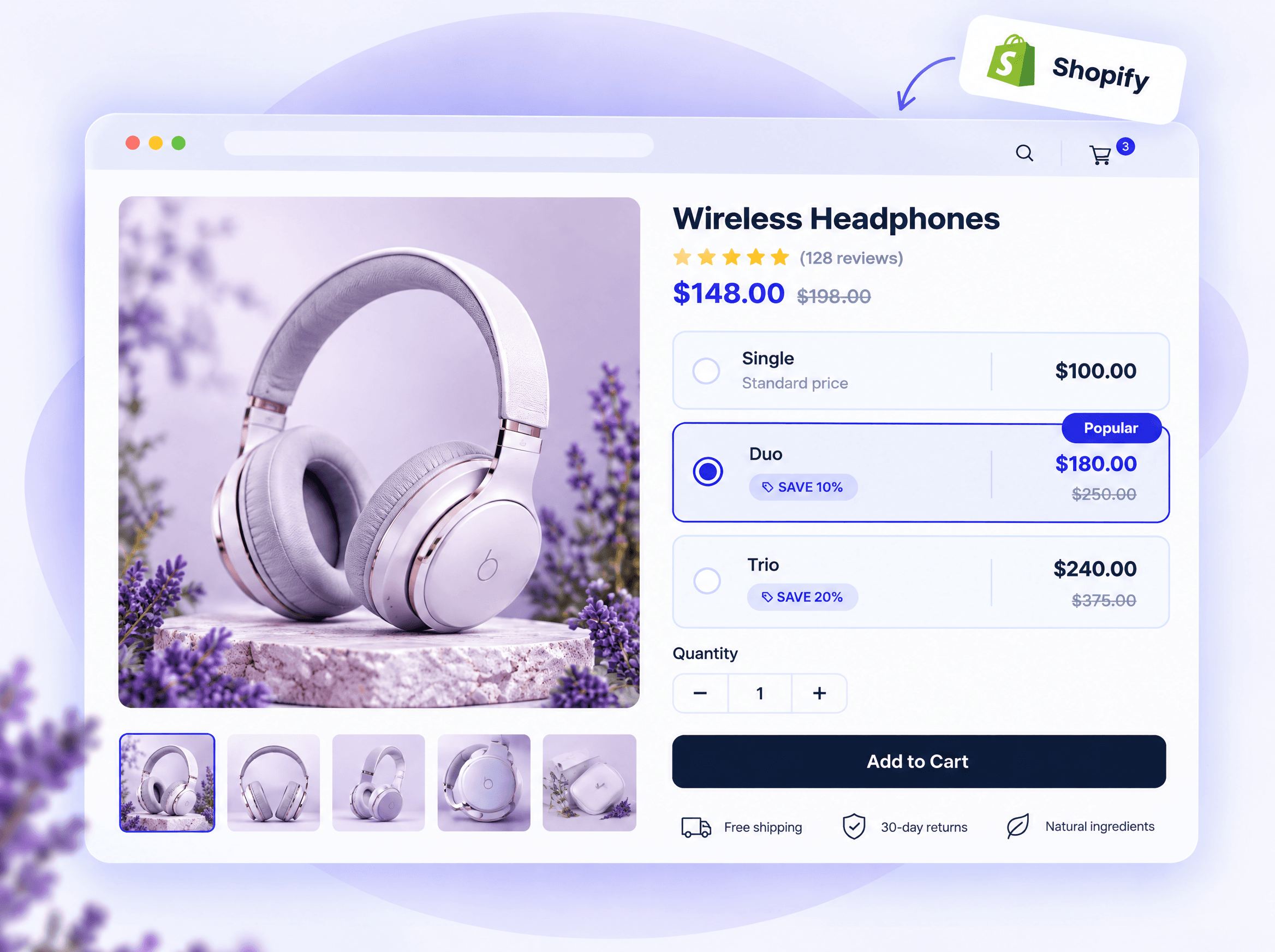
Key Takeaways
- Start from your per-item margin floor, not from a discount percentage that "feels right."
- Tiered quantity pricing (buy 2, save 10%; buy 3, save 20%) generally outperforms a single flat bundle discount because it rewards incremental purchases instead of discounting every buyer equally.
- Set your deepest tier discount well below what you'd offer in a sitewide sale — you can increase it later, but pulling back a discount customers expect is much harder.
- Track conversion rate by tier, not just total bundle revenue, so you can see whether your top discount is actually earning its margin cost.
- Re-evaluate bundle pricing whenever your cost of goods changes, not on a fixed schedule.
Why Most Bundle Pricing Starts in the Wrong Place
The most common mistake in bundle pricing is picking a discount percentage because it feels generous, then working backward to see if the margin survives. That order of operations almost always ends in a bundle that converts well and loses money.
The better starting point is your unit economics. Before you set any bundle discount, you need three numbers for every product going into the bundle: your cost of goods, your target gross margin, and the absolute floor margin you're willing to accept on a bundle sale. A bundle is a promotional vehicle, not a clearance mechanism — the floor should still leave room for payment processing fees, return rates, and fulfillment costs specific to multi-item orders.
Once you know your floor, the discount ceiling calculates itself: it's the maximum percentage off the combined list price that still clears your floor margin, after accounting for the fact that bundles often have a higher average item count per order and therefore different per-order fulfillment costs than single-item purchases.
Tiered Pricing Beats a Single Flat Discount
A single bundle discount — say, "buy the 3-piece set and save 15%" — has one structural weakness: it offers the same discount to a customer who was always going to buy all three items and to a customer who would have bought only one. You're discounting demand you didn't need to discount.
Tiered quantity pricing solves this by making the discount proportional to commitment:
- Single item — full price, no discount
- Two items — a modest discount (commonly in the 10% range)
- Three or more items — a deeper discount (commonly in the 15-20% range)
This structure rewards customers for buying more without discounting the baseline purchase, and it gives price-sensitive shoppers a reason to add one more item instead of walking away. It also reads more clearly on a product page than a single bundle price, because the customer can see the value of each step up.
How to Set Your Starting Discount Depth
A reasonable anchor point: set your top-tier bundle discount at roughly half of what you would be comfortable offering in a sitewide clearance sale. If a 40% storewide sale wouldn't alarm you from a margin standpoint, a 20% top-tier bundle discount is a defensible starting point to test.
This matters for a reason beyond math. Discounts are sticky in customers' expectations. Once a segment of your audience learns that your 3-item bundle is reliably 20% off, raising that to 25% is a minor adjustment — but lowering it back to 15% reads as a price increase and can measurably hurt conversion, even though the underlying "deal" framing hasn't changed.
This asymmetry has a well-established basis in behavioral economics: Kahneman and Tversky's prospect theory showed that people evaluate outcomes as gains or losses relative to a reference point, and that losses are weighted more heavily than equivalent gains — "losses loom larger than gains" (Kahneman & Tversky, 1979, Econometrica). A customer's "reference point" for your bundle becomes whatever discount they've come to expect, which is exactly why starting conservative and increasing based on data is a much easier path than starting aggressive and correcting downward.
Measure Conversion by Tier, Not Just Bundle Revenue
Total bundle revenue is a lagging, noisy signal. A bundle can generate strong total revenue while still having a badly priced top tier, if the lower tiers are doing all the conversion work.
The more useful metric is conversion rate broken out by tier:
| Tier | What to track |
|---|---|
| Single item | Baseline add-to-cart rate with no bundle discount shown |
| Mid tier | Conversion lift versus single-item baseline |
| Top tier | Conversion lift versus mid tier, weighed against the extra margin given up |
If your top tier isn't converting meaningfully better than your mid tier, you're giving away margin without a matching lift in behavior. That's a signal to narrow the gap between tiers, not necessarily to remove the top tier altogether — some customers will always want the "best deal" option even if most buyers land on the middle tier.
When to Revisit Your Bundle Pricing
Don't treat bundle pricing as something you set once. Revisit it when:
- Your cost of goods changes — a shift in supplier pricing changes your margin floor immediately, and a bundle discount that was safe a quarter ago may not be anymore.
- You add or remove an item from the bundle — the margin math resets with every product swap.
- A tier consistently underperforms — if a tier gets a small fraction of bundle orders over a meaningful sample size, it's either priced wrong or positioned wrong on the page.
- You're running a sitewide promotion — stacking a sitewide discount on top of an already-discounted bundle can push you below your margin floor without anyone noticing until the numbers come in.
Once your pricing tiers are set, the structure you build them into matters too — see BOGO vs. volume discounts for which structure fits a given category, and mix & match bundles for when customer choice outperforms a fixed set.
Frequently Asked Questions
Should every bundle use the same discount percentages? Not necessarily. Categories with thinner margins (consumables, for example) often need shallower discount tiers than categories with more margin room (apparel, accessories). Set tiers per product category rather than applying one global discount scheme.
Is a flat bundle price ever better than tiered quantity pricing? Yes, for bundles where the product combination itself is the value proposition — a fixed starter kit, for example, where the items are typically bought together as a set rather than as individually optional add-ons. Tiered pricing is better suited to bundles built from a single product family where quantity, not combination, drives the offer.
How much margin should a bundle discount leave on the table? There's no universal number — it depends on your category, return rate, and fulfillment cost per order. The discipline that matters is defining your floor margin before setting the discount, not after.
Can bundle discounts be combined with storewide sales? Technically yes, but it needs explicit guardrails. Decide in advance whether bundle discounts stack with sitewide promotions, and make sure your margin floor still holds in the worst-case stacked scenario before you allow it.
Ready to set up bundles on your own store?
Install CMX Bundles